

How to calculate the stress on a pipe flange?
As a pipe flange supplier, I often encounter customers who are concerned about the stress on pipe flanges. Understanding how to calculate this stress is crucial for ensuring the safe and efficient operation of piping systems. In this blog post, I will guide you through the process of calculating the stress on a pipe flange, covering the key factors and methods involved.
1. Understanding the Basics of Pipe Flange Stress
Before delving into the calculations, it's important to understand what causes stress on a pipe flange. Stress in a flange can be induced by various factors, including internal pressure, external loads (such as weight or vibration), and thermal expansion or contraction. The stress can lead to deformation, leakage, or even failure of the flange if not properly managed.
There are different types of stress that a pipe flange may experience:
- Hoop stress: This is the circumferential stress around the flange due to internal pressure. It tends to stretch the flange in the circumferential direction.
- Radial stress: Radial stress acts in the radial direction from the center of the flange. It is also affected by internal pressure and can cause the flange to expand or contract radially.
- Bending stress: Bending stress occurs when the flange is subjected to external loads or moments, such as when the pipe is misaligned or when there are significant thermal gradients.
2. Factors Affecting Flange Stress
Several factors influence the stress on a pipe flange. Here are the main ones:
- Internal pressure: The higher the internal pressure in the pipe, the greater the hoop and radial stresses on the flange. This is because the pressure acts uniformly on the inner surface of the flange, creating forces that try to expand the flange.
- Flange dimensions: The size, thickness, and diameter of the flange play a significant role in determining the stress levels. A thicker flange can generally withstand higher stresses than a thinner one. Similarly, larger diameter flanges may experience different stress distributions compared to smaller ones.
- Material properties: The mechanical properties of the flange material, such as its yield strength, ultimate tensile strength, and modulus of elasticity, are crucial. Different materials have different abilities to resist stress. For example, stainless - steel flanges may have different stress - bearing capacities compared to carbon - steel flanges.
- External loads: Any external forces acting on the flange, such as the weight of the pipe, the forces from equipment attached to the pipe, or seismic loads, can contribute to the overall stress. Vibration can also cause cyclic stress, which may lead to fatigue failure over time.
- Temperature: Thermal expansion or contraction due to temperature changes can generate additional stress in the flange. If the pipe and flange are restricted in their movement during temperature variations, high stresses can develop.
3. Calculation Methods
3.1. Simplified Analytical Methods
For simple cases, we can use some simplified analytical formulas to estimate the stress on a pipe flange.

Hoop stress calculation:
The hoop stress ($\sigma_h$) in a thin - walled pipe flange (where the wall thickness $t$ is much smaller than the diameter $D$) can be calculated using the following formula:
$\sigma_h=\frac{PD}{2t}$
where $P$ is the internal pressure, $D$ is the mean diameter of the flange, and $t$ is the wall thickness of the flange.
Radial stress calculation:
The radial stress ($\sigma_r$) at the inner surface of a thin - walled flange is approximately equal to the negative of the internal pressure, i.e., $\sigma_r=-P$. At the outer surface, the radial stress is zero.
However, these simplified formulas have limitations. They assume a uniform stress distribution and are mainly applicable to thin - walled flanges under pure internal pressure.
3.2. More Advanced Methods - Finite Element Analysis (FEA)
For more complex situations, such as when there are combined loads, non - uniform stress distributions, or complex geometries, Finite Element Analysis (FEA) is a more appropriate method.
FEA involves dividing the flange into a large number of small elements (finite elements). Each element has its own set of equations that describe its mechanical behavior. By solving these equations simultaneously, we can obtain a detailed stress distribution map of the entire flange.
The steps for performing FEA on a pipe flange are as follows:
- Model creation: Create a 3D model of the flange using CAD software. Include all the relevant details, such as bolt holes, gaskets, and any attached components.
- Mesh generation: Divide the 3D model into a mesh of finite elements. The quality of the mesh can significantly affect the accuracy of the results.
- Material definition: Define the material properties of the flange, such as its density, Young's modulus, and Poisson's ratio.
- Load and boundary condition application: Apply the internal pressure, external loads, and appropriate boundary conditions to the model. For example, if the flange is bolted to another component, the bolt pre - loads and the contact conditions need to be accurately defined.
- Analysis and post - processing: Run the FEA software to solve the equations and obtain the stress results. The software will generate color - coded stress maps, which can help us identify the areas of high stress.
4. Importance of Accurate Stress Calculation
Accurate stress calculation is essential for several reasons:
- Safety: By calculating the stress on a pipe flange, we can ensure that the flange can safely withstand the expected loads. This helps prevent flange failure, which could lead to leaks, spills, or even explosions in some cases.
- Cost - effectiveness: Knowing the stress levels allows us to select the appropriate flange size and material. Over - designing the flange by using a larger or more expensive material than necessary can increase costs. On the other hand, under - designing can lead to premature failure and costly repairs.
- Compliance: Many industries have strict regulations and standards regarding the design and operation of piping systems. Accurate stress calculation helps ensure compliance with these standards.
5. Related Products and Their Role in Flange Stress Management
As a pipe flange supplier, we also offer a range of related products that can help manage flange stress.
Stainless Steel Nut: Stainless Steel Nut are often used in conjunction with pipe flanges. They provide a secure connection and help distribute the load evenly across the flange. Stainless steel has good corrosion resistance, which is important in environments where the flange and nuts may be exposed to moisture or chemicals.
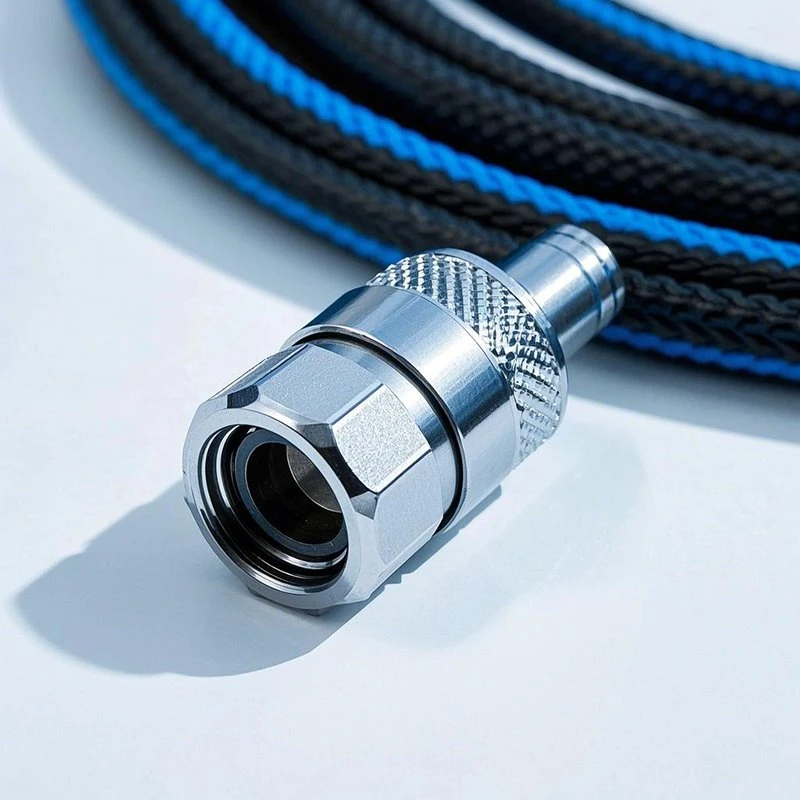
High Pressure Hose Pipe Connector: High Pressure Hose Pipe Connector are used to connect pipes or hoses to the flange. They need to be able to withstand high pressures without leaking. A well - designed connector can reduce the stress concentration at the connection point and improve the overall performance of the piping system.
Metric Nuts: Metric Nuts are available in a variety of sizes and thread pitches. They are commonly used in metric - sized pipe flanges. The correct selection of metric nuts is crucial for ensuring a proper fit and effective load - bearing capacity.
6. Conclusion and Call to Action
Calculating the stress on a pipe flange is a complex but essential task for the safe and efficient operation of piping systems. Whether you use simplified analytical methods or more advanced FEA techniques, understanding the key factors and following the correct procedures is vital.
As a pipe flange supplier, we are committed to providing high - quality flanges and related products. Our team of experts can assist you in selecting the right flange for your application and can also offer advice on stress calculation and management.
If you are in the market for pipe flanges or need help with stress analysis, we encourage you to contact us for a consultation. We look forward to working with you to ensure the success of your piping projects.
References
- "Pipe Flange Design Handbook" by an industry - recognized author (can be found in engineering libraries)
- ASME B16.5 Standard for Pipe Flanges and Flanged Fittings, which provides guidelines on flange design and stress considerations.
- Journal articles on finite element analysis of pipe flanges published in engineering journals such as the "Journal of Pressure Vessel Technology".